
The habit of burning household waste remains a common everyday sight in Banyakprodo Village, Tirtomoyo Subdistrict, Wonogiri Regency, a habit long practiced without most residents being fully aware of its exact impact. Addressing this issue, Tsuraya Safa Zerlina, a Statistics student at Diponegoro University (Undip), developed a Statistical Data Infographic to Support the Eco Corner Program as part of the multidisciplinary work program of Undip’s Community Service Program (KKN), Team II, Academic Year 2025/2026, themed “My Waste, My Responsibility: Toward a Burn-Free Banyakprodo”.
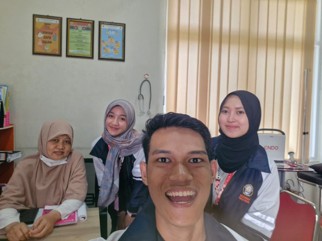
The activity began with joint observation involving residents and Banyakprodo Village officials, which revealed that burning waste without separating organic and inorganic materials was still a common practice. Based on these initial findings, a secondary data study was conducted using sources from the Wonogiri Environmental Agency (DLH), the Central Statistics Agency (BPS), and the Ministry of Health (Kemenkes), which was then combined with an interview with the Village Midwife on 22 July 2026 to gain a clearer picture of residents’ health conditions related to the impact of waste burning in Banyakprodo Village.
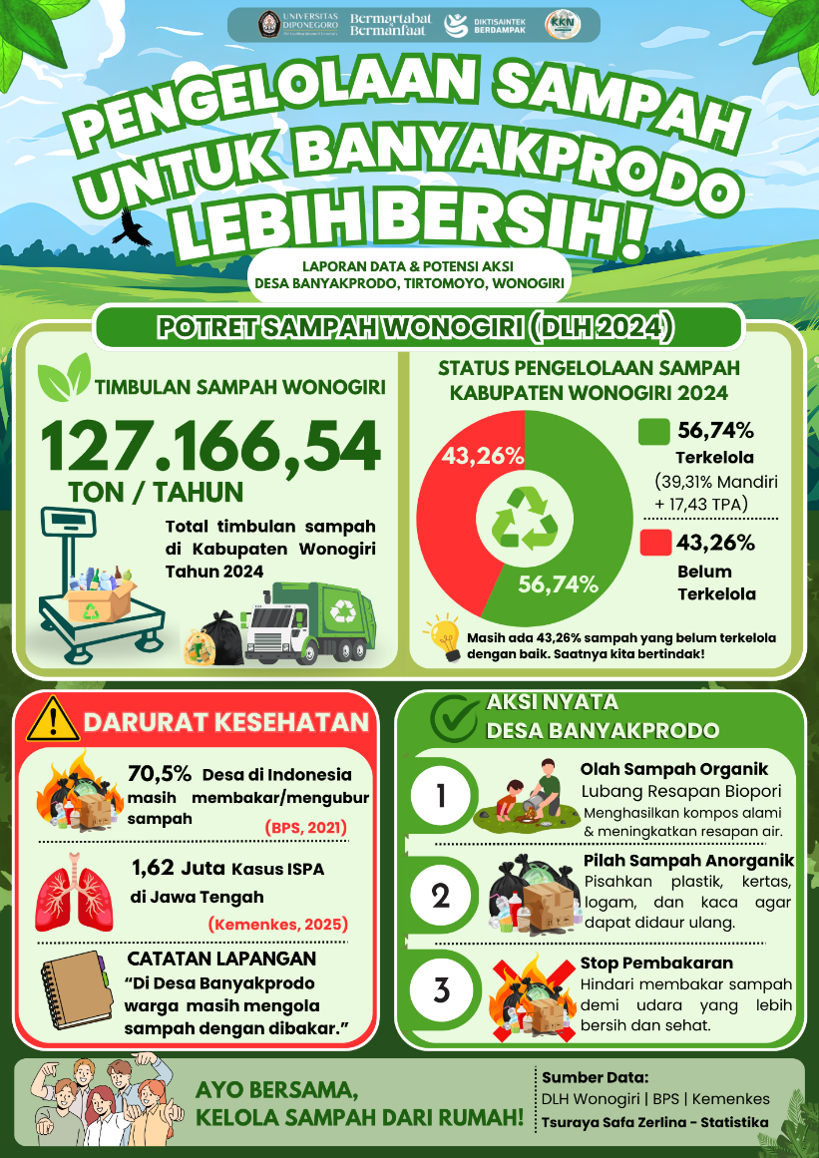
The data collected paints a fairly concerning picture. Total waste generation in Wonogiri Regency reaches 127,166.54 tons per year, with 43.26 percent of it still not properly managed (DLH Wonogiri, 2024). Nationally, 70.5 percent of villages in Indonesia are known to still burn or bury waste as their primary disposal method (BPS, 2021), while Central Java recorded 1.62 million cases of Acute Respiratory Infection (ARI) closely linked to air pollution, including smoke from waste burning (Kemenkes, 2025). Field notes from Banyakprodo Village further confirmed that local residents still manage household waste by burning it.
This data was then processed and visualized into an infographic poster titled “Pengelolaan Sampah untuk Banyakprodo Lebih Bersih!” (“Waste Management for a Cleaner Banyakprodo”), featuring three simple concrete actions to encourage behavioral change among residents: processing organic waste through biopore infiltration holes, sorting inorganic waste for recycling, and stopping the habit of burning waste for cleaner, healthier air.
The infographic poster was then installed directly at the Eco Corner point of the Banyakprodo Village Office, serving as a visual educational medium accessible to residents and visitors to the village office alike. Developing the infographic came with its own challenges, as official village-level data on waste disposal and burning habits was not yet documented, meaning much of the local data had to be drawn from field observations and direct interviews with relevant parties.
This program represents one form of KKN students’ contribution to supporting the achievement of the Sustainable Development Goals (SDGs), particularly SDG 3 (Good Health and Well-Being) and SDG 11 (Sustainable Cities and Communities), through a data-driven approach to encouraging behavioral change toward more responsible waste management. Going forward, the local data featured in this infographic is expected to be continuously updated alongside the strengthening of Banyakprodo Village’s Eco Corner governance.
Author: Tsuraya Safa Zerlina
Study Program: Statistics, Faculty of Science and Mathematics, Diponegoro University
Program: Multidisciplinary Work Program, KKN Team II, Diponegoro University, Academic Year 2025/2026
KKN Location: Banyakprodo Village, Tirtomoyo Subdistrict, Wonogiri Regency
Field Supervisors (DPL):
- Yuli Prasetyo Adhi, S.H., M.Kn. (NIP. 198107152006041001)
- apt. Almira Rahmayani, M.Pharm.Sci (NIP. 199601110126042008)
- Wildan Namora Ichsan Setiawan, S.I.Kom., M.Sc. (NPPU. H.7.199601012022101001)