
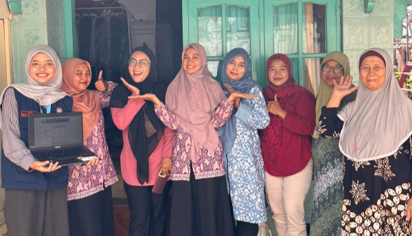
Batang — As part of the community social program under the 2026 Universitas Diponegoro’s KKN Reguler Team II, Elsa Ika Rahmani, a Statistics student at UNDIP’s Faculty of Science and Mathematics, initiated the development of an educational digital dashboard for monitoring toddler growth and development at the posyandu (integrated health post) in Klidang Lor Village, Batang. This dashboard was implemented together with posyandu cadres and the village midwife on Thursday (13/8) as a basis for decision-making and evaluation.
 UNDIP KKN student Elsa Ika running the community social program together with Posyandu Kenanga in Klidang Lor, Batang, Thursday (13/8).
Official recording of toddler growth and development in Indonesia is already facilitated through an application belonging to the Ministry of Health (Kemenkes). This dashboard is not intended to replace that system, but rather to serve as an additional educational and visualization medium at the village level. Weight, height/length, upper-arm circumference, and head-circumference data for the period January 2025–July 2026 were consolidated via Google Sheets and visualized in real time on Looker Studio, complete with attendance trend charts and an Individual Tracker panel.
This program stands as a concrete example of applying statistics directly within the community, ranging from database design to automatic conditional filtering that sorts toddlers showing signs of weight decline into an Attention List feature. This feature reduces the burden of manual recapitulation by cadres, which is prone to recording errors, while also making it easier for the midwife to quickly and transparently monitor toddlers’ growth conditions across posyandu using benchmark metrics.
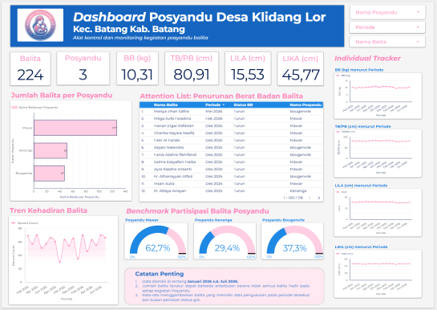 Visualization of the toddler development dashboard at the Posyandu in Klidang Lor, Batang.
In addition, one recommendation that received direct appreciation from Klidang Lor Village Midwife Titis was the structured Unique Code System (Toddler ID), such as MWR-001 or KNG-002, generated automatically.
“This ID recommendation is really good, because until now we’ve often made mistakes writing names. Like the name Kezia, but what gets written is Kesya. When I input it into the Kemenkes system, it can’t be found. It turns out the name was written wrong. With an ID like this, each child’s record becomes clearer and won’t get mixed up, because each toddler has a different ID,” said Titis, the Village Midwife, responding to the feature.
A system demonstration and knowledge transfer were also carried out directly with the midwife and posyandu cadres so that the dashboard can be applied within their routine workflow. This KKN program is not merely a technical innovation on paper, but a solution whose benefits are genuinely felt by the village community.
Author: Elsa Ika Rahmani