
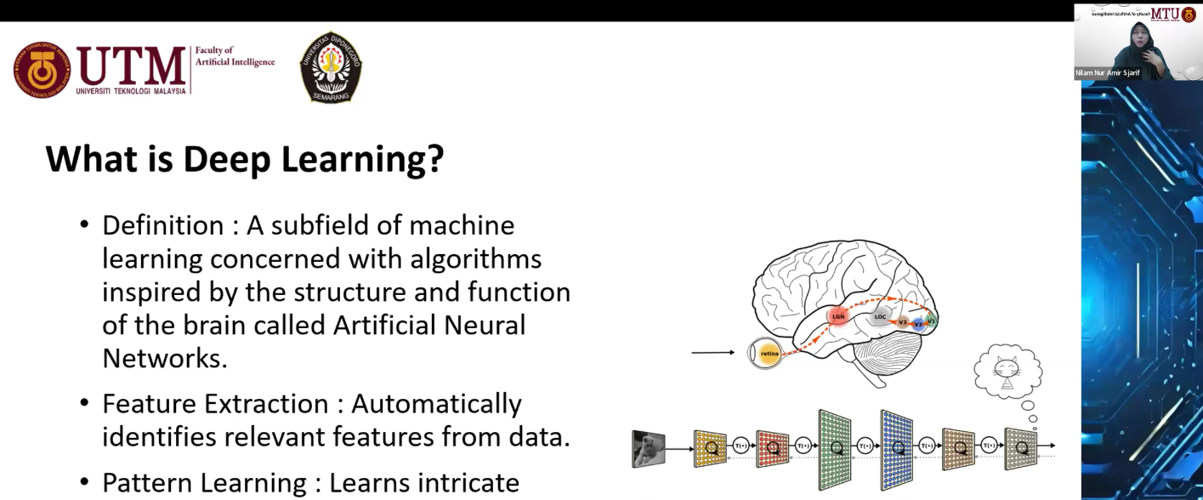
The Department of Statistics, Faculty of Science and Mathematics, Diponegoro University (UNDIP) again held the Undip Global Classroom activity as part of efforts to internationalize education and improve the quality of learning. On this occasion, the Department of Statistics presented an international speaker, Dr. Nilam Binti Nur Syarif, a lecturer from the Faculty of Artificial Intelligence, Universiti Teknologi Malaysia (UTM).
This academic activity raised the topic of “Convolutional Neural Network (CNN)”, one of the important methods in the field of artificial intelligence and machine learning, especially in image- and pattern-based data processing.
In his presentation, Dr. Nilam explained the basic concepts to the development of CNN as part of deep learning. CNN is a method that is used in various modern applications such as facial recognition, image classification, to automated systems based on computer vision. Participants were invited to understand how the structure of artificial neural networks works through convolution, pooling, and fully connected layers.
This activity was attended by students and lecturers of the Department of Statistics who showed high enthusiasm through interactive discussions. Participants gained insight into the implementation of CNN in the real world, including its application in various fields such as industry, health, and information technology.
Dr. Budi Warsito as the PIC of the activity said that the Undip Global Classroom activity is one of the strategic steps to expand international networks while improving the global competence of students.
In addition to enriching academic insights, this activity also opens up collaboration opportunities between Diponegoro University and Universiti Teknologi Malaysia, both in the fields of education, research, and scientific development.
With the implementation of this activity, the Department of Statistics UNDIP affirms its commitment to supporting student capacity strengthening in the era of digital transformation and preparing graduates who are adaptive to global technological developments.