
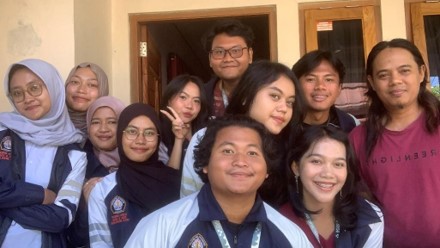
Branjang – Until now, MSMEs in Branjang Village, West Ungaran District, Semarang Regency, have operated without any measuring tools to assess the extent to which their products and business management meet government standards. To address this issue, Diponegoro University (UNDIP) Multidisciplinary Community Service Program students developed an assessment instrument to assess MSME product compliance with government standards—a simple assessment tool to map business readiness in a measurable, consistent, and repeatable manner.
The program, initiated by Desy, a student of the Statistics Study Program, Faculty of Science and Mathematics (FSM) UNDIP, is part of the multidisciplinary theme “Integrated Model of MSME Capacity Development through the Integration of Legality, Governance, Product Standardization, Production, and Digitalization in Supporting the Strengthening of the Branjang Village Creative Market.”
The problem the KKN team found in the field lay not solely in the lack of empowerment programs, but also in the absence of measurement tools. Without a systematic assessment instrument, evaluations of MSME suitability tended to be subjective, inconsistent across assessors, and difficult to use as a basis for decision-making. As a result, mentoring achievements could only be claimed narratively without comparable data.
“We know there are rules for entering minimarkets, but we never know which areas meet standards or not,” said Mr. Sehono, one of the mentoring participants.
The instruments were developed through regulatory review and literature review, then separated into two versions based on business characteristics. The instrument for food MSMEs covers compliance with government standards and food labeling and packaging, while the instrument for non-food MSMEs covers key indicators of government standards and supporting indicators for business management. Each indicator clearly differentiates between those required by applicable regulations and those considered best practices, a distinction often blurred in typical empowerment checklists.
This is where the science of statistics comes in. The abstract concept of “business readiness” is translated into a measurable construct: each indicator is graded in stages, from not yet met to already met.
fulfilled, then converted into percentage achievement and grouped into three categories with explicit thresholds: Not Ready, Fairly Ready, and Ready. This written threshold ensures that assessment results are consistent across assessors and remain comparable when repeated assessments are made.
The assessment was conducted directly by KKN students through interviews and observations of documents and production conditions at the business locations. The results varied: Perfume and Sigur ID MSMEs were in the Ready category, Coffee MSMEs were in the Fairly Ready category, while Milk MSMEs were still Not Ready. This diversity emphasized that mentoring cannot be standardized, so recommendations for improvement were developed specifically for each MSME.
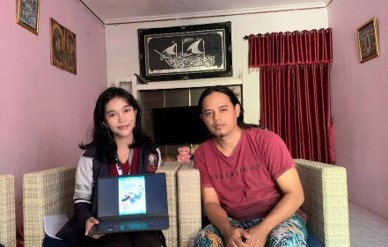
“This instrument allows us to know exactly where each MSME stands, rather than just guessing. The value of this program lies not in the assessment we produce today, but in the more targeted direction of our assistance,” said Desy.
For Statistics students, this program provides a hands-on opportunity to apply the knowledge they’ve learned in the classroom, from operationalizing variables and developing measurement scales to processing and interpreting assessment results. The experience of translating regulatory provisions into measurable indicators also provides them with skills rarely learned from secondary data processing: ensuring the resulting figures accurately represent conditions on the ground.
Through this program, MSMEs are expected to gain a clear picture of their business’s position against government standards and provide a basis for determining the most urgent improvement steps. Ultimately, this program emphasizes that empowerment without measurement risks remaining an activity, not a change.
Author: Desy Angriani Siahaan
Supervisor: Gani Nur Pramudyo, M.Hum.